Networking & AI
Your AI Destination Is a Network Decision, Not Just an API Decision
Cisco’s AI Transit announcement is a useful prompt for buyers: when AI workloads run outside your usual cloud estate, preserve the same routing, access and ownership discipline.
When an application starts using an AI service, does your network still know where the data is going?
Adding an AI feature to a business application can look deceptively simple: obtain an endpoint, add credentials and send requests. But the traffic may now travel to a new cloud, managed service or specialized AI provider outside the routes, policies and review habits your IT team already uses.
Cisco announced AI Transit on November 2. Cisco says the capability is designed to extend an existing SD-WAN policy model to AI environments, including specialized cloud destinations, rather than treating those connections as separate one-off paths. Cisco’s November 2 announcement is the primary source. Cisco’s SD-WAN solution overview provides background on its cloud-connectivity model.
These are Cisco product descriptions, not independent proof of security outcomes or a reason to replace a current network. The transferable lesson is that every new AI destination should enter a documented network and data-governance process.
What changed—and what has not
Cisco describes AI Transit as a way to carry established routing, segmentation, security and application policies into AI-oriented destinations. That may be useful for organizations already using the relevant Cisco platform, but the announcement does not establish compatibility, licensing, availability or suitability for a particular environment. Confirm those details with Cisco or an authorized provider.
The fundamentals have not changed. A business still needs to decide which applications may send data externally, what categories of information are permitted, which identities can make the calls, how traffic is monitored and what happens if the destination is unavailable. An AI endpoint does not remove those questions; it makes them more urgent because the application may process customer records, internal documents or operational data.
Start with the data path
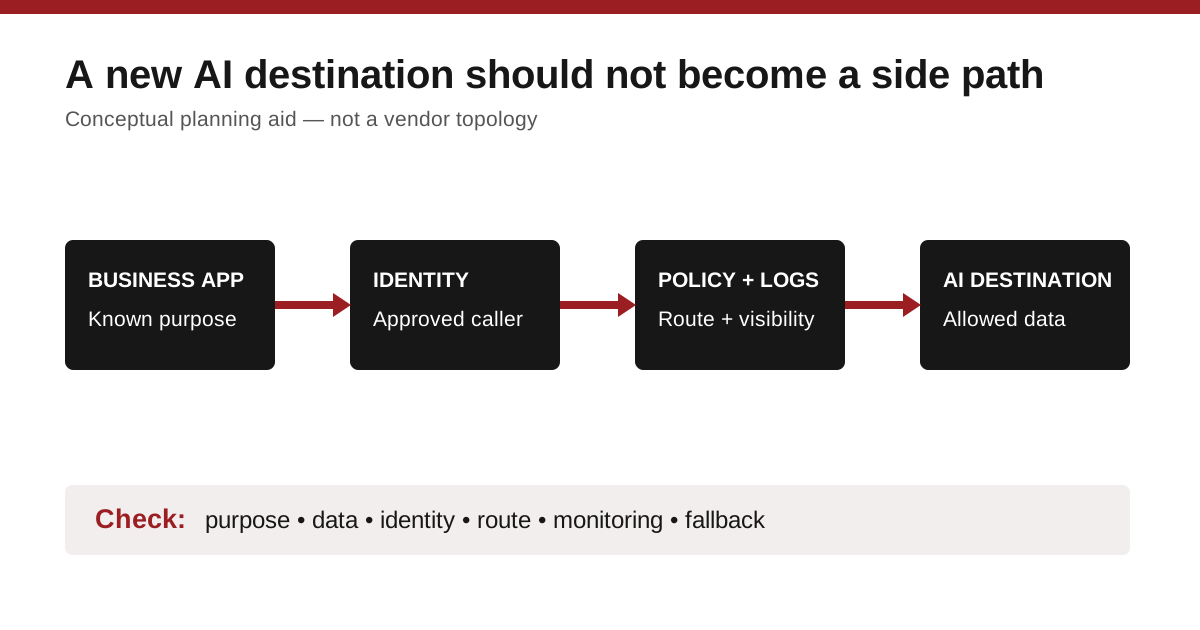
Before approving a new AI integration, draw one simple path: user or application, identity, network exit, AI destination, response and logging. Then add the controls already used for other important services. Is the connection encrypted? Is access limited to the application rather than a shared credential? Is the route visible to the team that investigates incidents? Can the application fail safely if the service is slow or unavailable?
This is not a demand for a complex architecture. It is a way to avoid discovering later that an experimental feature became a permanent, poorly understood data path.
The diagram below is an original DC Supplies planning aid. It is not a Cisco topology or a guarantee that any specific product provides these controls.
Make an AI-destination intake checklist
A short intake sheet can improve both purchasing and security decisions:
- Purpose: What business task will the integration perform, and what result would make it worthwhile?
- Data: What information will be sent, retained or returned? Include attachments, logs and prompts—not just the final answer.
- Identity: Which workload identity or user role is permitted to call the service? Avoid sharing personal administrator credentials.
- Network: Which approved route, DNS name or private connection is used, and who monitors it?
- Resilience: What does the application do when the provider is slow, unreachable or changes a service limit?
- Evidence: Where are the approval, configuration and periodic review recorded?
Request that a provider demonstrate the proposed path in a non-production environment. Have them show the source application, the authorization method, the destination, the monitoring view and the failure behavior. That demonstration is more useful than a generic claim that a connection is “AI ready.”
Tradeoffs for smaller teams
A direct public-internet connection may be quick to set up and adequate for a low-risk pilot using non-sensitive test data. As an integration becomes business-critical or handles more sensitive information, the team may need stronger identity controls, clearer egress rules, better logging and a tested fallback. Those measures add effort and sometimes cost, but they can reduce the chance that an unreviewed connection becomes a blind spot.
Do not assume that a dedicated connection is automatically necessary or that a single vendor is required. Compare the options against the actual data classification, uptime need, staff capability and existing network platform. The right decision is proportional to the risk and the value of the application.
The practical question
Cisco’s announcement is a timely reminder that AI infrastructure is often distributed. For IT buyers, the goal is not to make every new tool complex. It is to keep the same basic ownership and visibility when workloads leave the familiar network boundary.
Before the next AI feature ships, ask: can we show the approved path, the identity making the request, the information allowed to travel and the plan if the destination fails? If not, the network design is not finished.
Sources and editorial note
- Cisco AI Transit announcement — published November 2, 2026; accessed November 3, 2026. Primary source for the announced capability.
- Cisco SD-WAN solution overview — background documentation accessed November 3, 2026.
Cisco claims are attributed. This article does not claim hands-on testing, customer results, product availability, security guarantees or DC Supplies inventory.