AI & infrastructure
Before buying more AI compute, check how your data moves
Oracle and AMD's latest cloud announcements raise a practical question: is your next technology investment aimed at the real bottleneck?
If an AI application feels slow, the obvious shopping question is often: do we need more compute? This week's infrastructure announcements suggest a better opening question: where is the application spending its time?
On October 27, Oracle announced new Oracle Acceleron networking capabilities for its cloud infrastructure. The announcement covers data movement, storage connectivity and resilience when network paths fail. These are vendor-announced capabilities, not results from DC Supplies testing. Oracle announcement
For a business planning its next technology investment, the useful conversation is broader than a single cloud product: how do you avoid buying capacity that leaves the actual bottleneck untouched?
What changed this week
Oracle describes a high-performance fabric that brings RDMA connectivity to front-end compute, alongside expanded NVMe block-storage attachment options. It also describes a communications library designed to route distributed AI traffic across healthier network paths. Availability and suitability need checking for the particular service and configuration; Oracle's announcement includes a future-product disclaimer. Announcement and scope
Separately, AMD described its role in upcoming OCI Compute E7 instances and Oracle Acceleron converged network adapters. AMD says Pensando data processing units can handle networking, storage and security functions that would otherwise consume host CPU capacity. That is an architectural direction, not evidence that every workload will see the same benefit. AMD's October 27 update
Neither announcement is a reason for a small business to copy a hyperscale design. Together, they provide a timely reason to examine the work surrounding an AI model.
Follow one request through the system
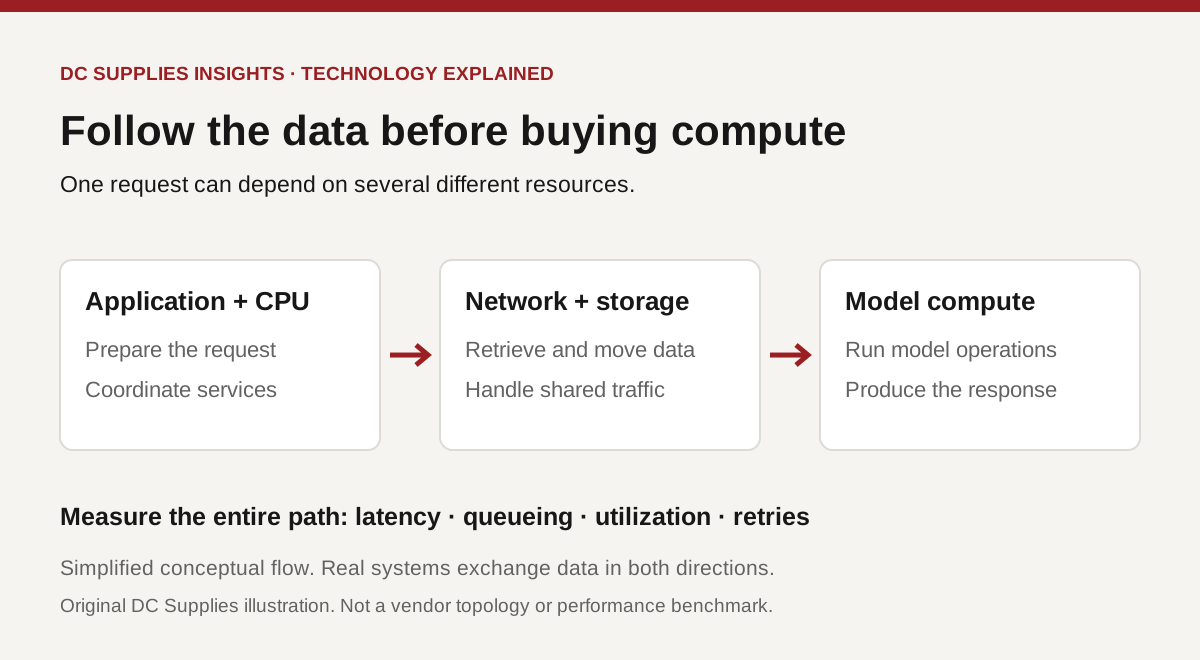
Imagine a team assistant answering a question using company documents. As an illustrative example, its application may authenticate a user, search for relevant information, retrieve that information and pass a prepared request to a model. The model's answer then returns through the application.
This example is a way to structure an investigation, not a claim about a particular vendor's implementation. At each stage, ask what the request is waiting for. Is the delay in document retrieval? Is a service queue growing? Does the application spend time retrying requests? Is model processing itself the longest stage?
A faster component is useful only if it improves something the business actually experiences. Before changing the hardware list, agree on the outcome: a shorter wait for employees, more simultaneous users, or a lower cost for an acceptable response.
Why networking belongs in the discussion
RDMA means remote direct memory access. Oracle's technical explanation describes moving data between machines' memory with limited CPU involvement, reducing parts of the software processing used in conventional transfers. It also explains why mixed traffic, congestion and packet loss complicate that approach. Oracle technical explanation
The lesson for a buyer is not simply “choose the fastest network.” It is to ask which traffic matters and how the proposed system behaves when several workloads compete. A storage transfer, a user-facing request and communication between compute nodes may place different demands on the infrastructure.
Our interpretation: average performance alone is an incomplete purchasing conversation. Ask to see behavior during busy periods and recovery from a failure, alongside normal operation. A demonstration should resemble your workload closely enough to help answer a business question.
A practical conversation before the next purchase
Start with a small, measurable pilot. Choose one representative workflow and record its response time, concurrency and cost under an agreed test. Document the configuration so the result can be repeated.
Then take these questions to your IT team or supplier:
- What is the measured constraint? Ask for evidence showing where time or capacity is being lost before choosing an upgrade.
- What changes in this proposal? Separate CPU capacity, model compute, storage access and network behavior rather than treating them as one improvement.
- What is included? Confirm software support, compatible components, deployment effort and ongoing operational responsibilities.
- What happens under pressure? Agree on a realistic busy-period test and a safe recovery test.
- What would make us stop? Define a result that would justify keeping the current setup or revising the proposal.
These are suggested evaluation questions, not a claim that every organization needs specialized networking hardware.
The conversation worth having
The latest announcement is a useful starting point. The stronger purchasing decision comes from connecting it to a measured problem.
Before adding another accelerator, faster adapter or larger cloud instance, map the path from the user's request to the finished answer. Then invest where the evidence points.
Discussion: If you had to improve one business application this quarter, could your team identify its slowest stage today?
Sources and editorial note
Sources were reviewed October 29, 2026. All three linked publications are dated October 27, 2026. Oracle and AMD are primary sources for their announcements, not independent validation of performance. The diagram is an original conceptual illustration; it is not a vendor topology. This article contains editorial analysis and does not claim hands-on testing.