Cloud & Infrastructure
Microsoft’s Cloud Growth Is a Reminder to Review Your Own Infrastructure Bill
What strong cloud growth does—and does not—mean for small-business infrastructure choices.
Microsoft’s Cloud Growth Is a Reminder to Review Your Own Infrastructure Bill
Microsoft reported another strong quarter for its cloud business on October 28. Reuters reported Azure revenue growth of 48%, alongside substantial spending on infrastructure to support cloud and AI demand. Those figures tell us that demand for large-scale computing remains strong. They do not tell a small business whether its next server, database, backup system, or AI experiment belongs in the cloud. Reuters, October 28; Microsoft company announcements, October 28.
For an IT manager with a limited budget, the useful question is more specific: which workloads benefit enough from cloud flexibility to justify ongoing charges, and which are predictable enough to run elsewhere?
What changed—and what did not
Microsoft announced its fiscal first-quarter results on October 28. Reuters described strong Azure growth and continued investment in computing capacity. That is evidence about Microsoft's business performance and investment plans, not a benchmark of cloud application speed, customer savings, or service reliability. It also does not establish that any particular server type is currently available to your company.
The timing matters because infrastructure budgets are often built around an overly simple choice: buy equipment or move everything to the cloud. Real environments are messier. A small firm may use cloud email and collaboration, keep a local file server, host its website with a managed provider, and run accounting software in a third-party service. Each component has a different cost and risk profile.
The bill is bigger than compute
A cloud virtual machine has a visible hourly or monthly rate, but that is only one part of its operating cost. Storage, backup retention, outbound data transfer, monitoring, security services, support, and the staff time needed to administer it can all matter. A modest application with a small server bill may become expensive when its data is copied repeatedly or retained indefinitely.
An on-premises server has the opposite problem: the purchase price is obvious, while electricity, replacement drives, warranties, network equipment, backup media, physical security, and downtime risk are easy to underestimate. Owning equipment is not automatically cheaper, especially when a company lacks the people to maintain it.
A sensible comparison uses a common period—often three years—and includes the same operational requirements on both sides. Count backup and recovery, not just production hardware. Count the people responsible for patching and incident response. And compare realistic utilization rather than assuming a server will run at full capacity every hour.
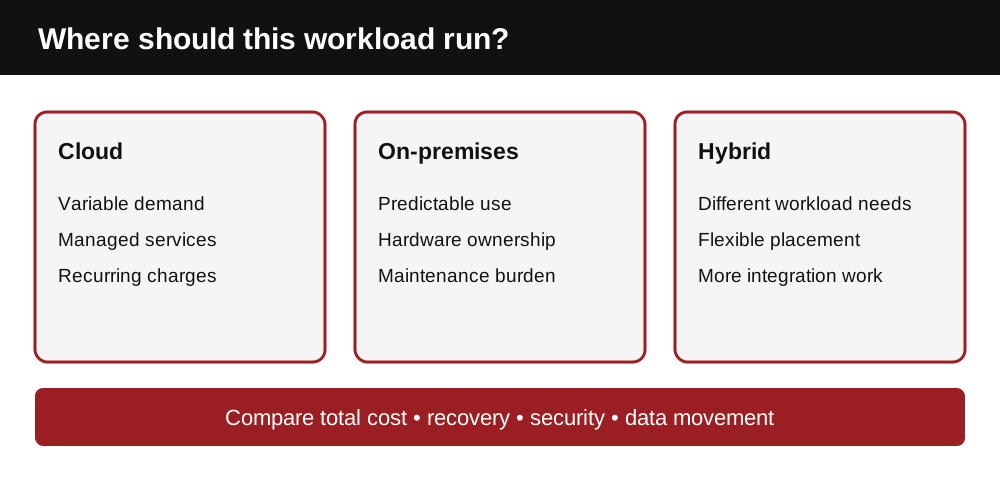
Match the location to the workload
Consider three common cases.
A customer-facing application with unpredictable demand may benefit from cloud scaling and managed services. The business can avoid sizing hardware for a peak that happens only occasionally. But the team should understand what happens when usage doubles and whether cost alerts can prevent surprises.
A stable internal application used by a fixed number of employees may be worth comparing against a local server or a fixed-price hosting arrangement. The calculation depends on licensing, resilience needs, support coverage, and whether remote access is essential. A cheap local box without dependable backup is not an equivalent substitute for a properly protected cloud service.
A growing archive or media library raises a different question: how often is the data accessed, how quickly must it be restored, and what will it cost to move? Low-cost storage can be attractive until retrieval, transfer, or long retention changes the economics. A backup copy that has never been restored in a test should not be treated as a proven recovery plan.
AI makes workload placement more complicated
A business testing AI might use an external API, a managed cloud model, or a local workstation or server. These are not interchangeable. Cloud services can reduce initial hardware commitments, while local systems may offer more control over certain data flows. Either route still requires security, permission management, evaluation of output quality, and a clear rule about what business information can be submitted.
Before purchasing a GPU server, estimate actual usage: how many requests, how much data, how often, and what response time matters? Before committing to an API, estimate recurring usage and set a spending ceiling. A small pilot with real—but non-sensitive—sample workloads is usually more informative than a vendor's headline specification. This is planning guidance, not a claim of measured performance.
Five questions to bring to the budget meeting
- What is the full three-year cost, including backups, licenses, network charges, support, and staff time?
- Which systems have variable demand, and which run predictably every day?
- How long can each system be unavailable, and how much data loss can the business tolerate?
- Can we export our data and move providers without a costly rewrite or surprise transfer bill?
- What usage alerts, spending limits, access controls, and recovery tests will be in place from day one?
Microsoft's latest results are a useful signal that cloud infrastructure remains an active investment area. They are not a purchasing instruction for every small business. The better decision starts with your workload, your recovery requirements, and your real operating costs—not the biggest provider's growth rate.
If you reviewed just one system this quarter, which would reveal the most: your backup storage, your always-on virtual machines, or the application nobody has costed since it launched?
References
- Microsoft, company press-release archive — first-quarter results announcement dated October 28, 2026; accessed October 29, 2026.
- Reuters, Microsoft's cloud growth and AI spending — published October 28, 2026; accessed October 29, 2026.