Storage & Security
A Storage Alert Can Help. It Still Isn’t Your Recovery Plan.
IBM’s latest FlashSystem update is a useful reminder: an alert about unusual reads may speed investigation, but resilient storage still depends on response, recovery and verification.
When a storage system raises an alert, what should happen next?
A new security feature can sound like an answer to a very old problem: how do we know someone is taking data before an attack becomes obvious? But an alert is only the beginning of a response. The important purchasing question is whether the team can turn that signal into a safe, practiced decision.
This week’s storage news provides a useful example. IBM says eligible FlashSystem 5600, 7600 and 9600 configurations using its fifth-generation FlashCore Modules now add data-exfiltration detection. IBM describes the feature as looking for unusual read behavior by volume and says it is available starting in October 2026 on eligible configurations. IBM’s update, October 23, 2026 is the primary source for those claims. StorageReview’s October 29 coverage independently describes the announced scope and firmware context.
Those are vendor-reported capabilities for a specific product family—not a claim that the feature will detect every incident, protect every application, or replace other security controls. For a small-business IT buyer, the more reusable lesson is how to evaluate an alerting capability before it becomes part of a resilience plan.
What changed—and what did not
IBM’s announcement extends its FlashSystem threat-detection story from suspicious encryption behavior to unusual reads that could indicate data leaving a system. IBM says the feature establishes a baseline for each volume and accounts for routine activities such as backups and analytics. The company also reports a false-positive rate below 1%; treat that as an IBM claim, not an independently verified result or a prediction for your environment.
An unusual-read alert is not proof of theft. A new backup job, migration, reporting process, administrator task or compromised account can create activity that needs context. Conversely, an attacker may use a path that a particular product does not observe. That is why a product demonstration should be the start of due diligence, not the finish line.
The announcement also does not make a platform universally available. “Starting in October” is not the same as “enabled on every installed array.” Exact hardware generation, software level, licensing, configuration, support status and regional availability all need confirmation with IBM or an authorized supplier before a purchase decision.
Put the alert into a response chain
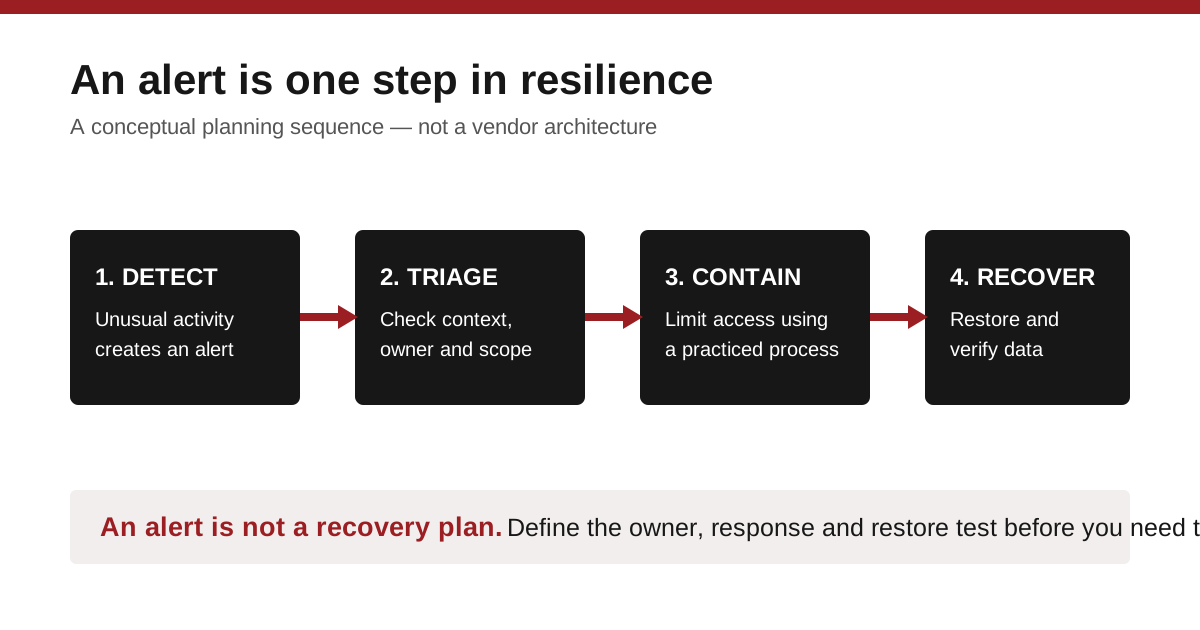
A useful security control has an owner and an action. Before adding any storage-level detection feature, write a short response chain:
- Detect: Which system creates the alert, and which kinds of activity are in scope?
- Triage: Who receives it, how quickly can they investigate, and what normal activity must they rule out?
- Contain: Who can pause access, isolate an affected account or stop a risky job without creating a larger outage?
- Recover and verify: Where is the known-good backup or immutable copy, and how will the team confirm it can restore the needed data?
The diagram below is an original DC Supplies planning aid. It is not an IBM architecture diagram and does not represent a certified incident workflow. Its point is simple: detection, containment and recovery are connected responsibilities.
Questions to ask before you buy—or renew
Start with coverage. Is the feature observing reads, writes, files, volumes, identities, network traffic or some combination? A storage signal can be valuable, but it will not provide the same view as identity, endpoint and network monitoring. Ask how alerts reach the people or tools that already handle incidents.
Then ask about operations. Request a documented demonstration using a non-production test environment: what starts an alert, what details are shown, how can an administrator label expected activity, and what happens when the alert is ignored? Do not ask a supplier to simulate a live attack against production data.
Finally, test the recovery claim separately. A backup that exists is not necessarily a backup that can be restored within the business’s required time. Pick a representative folder, database or virtual machine; restore it to a safe location; confirm its integrity and access; and record the elapsed time. This is a practical validation exercise, not a claim that any vendor’s hardware makes recovery automatic.
The business implication
Security features embedded in infrastructure can provide useful early evidence, especially when they reduce the time between an unusual event and a human investigation. But buying on the promise of one alert can create false confidence if responsibilities, access controls and restore testing remain unclear.
For teams considering a storage refresh, add one line to the evaluation worksheet: “Show us how the alert becomes a decision, and show us how we recover if the decision comes too late.” That question is valuable whether the final design uses IBM, another enterprise platform, a cloud service, or a simpler small-business backup stack.
What is one alert your team already receives that would be more useful if it arrived with a named owner, a response deadline and a tested recovery path?
Sources and editorial note
- IBM community update — published October 23, 2026; accessed October 30, 2026. Vendor source for feature scope and vendor performance statements.
- StorageReview — published October 29, 2026; accessed October 30, 2026. Independent technical coverage used to corroborate announced scope.
This article was prompted by sources from the preceding seven days (October 23–29), rather than the preferred 24–72 hours. IBM claims are attributed. No DC Supplies testing, customer results or product availability is claimed.